Lately I've been paying closer attention to the physical side of painting — the force, the resistance, the push and pull between my hand and the surface. It's become as important to me as the paint itself.
For a while, traditional canvas just wasn't giving me what I needed. There was too much give. When I applied pressure, the surface absorbed it without pushing back, and I found myself wanting more friction — more of a conversation between the brush and the ground. So I made the switch to wood panels.
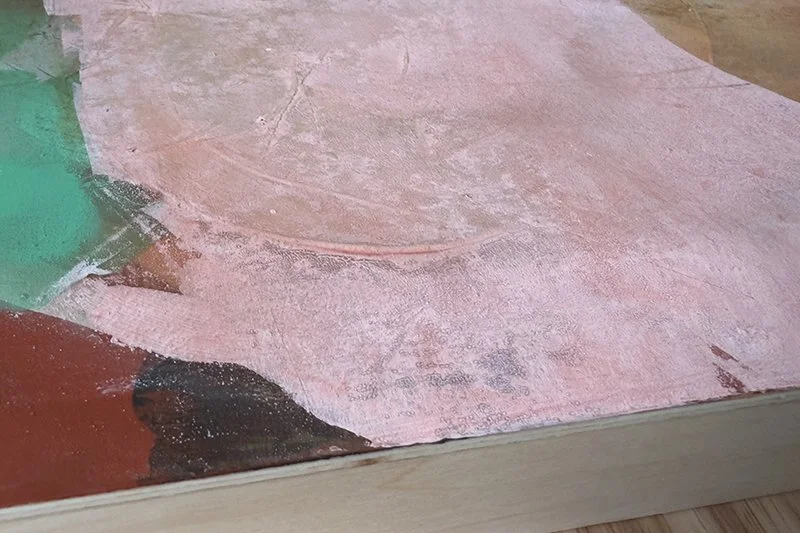
Irregular paint application on wood panel.
The difference was immediate. Wood has more tooth, which means the paint doesn't move as freely. You have to work for it, and I loved that. The resistance felt intentional. It changed the way I painted.
The problem was the price. Wood panels have become increasingly expensive, and the cost started to add up in a way that was hard to ignore. Recently, while restocking some supplies, I picked up a few canvases almost out of habit — and was struck by how inexpensive they were compared to panels. I bought six and brought them home with an idea.
I reached for a mortar trowel and applied a thick layer of acrylic ground for pastel across the entire surface of each one. The trowel doesn't lie — no matter how carefully you work it, the application is always slightly uneven. Peaks, ridges, thin spots. I don't fight that. I like it.
Once the ground dried, the surface behaved in a way I hadn't fully anticipated — and that's exactly what I was after. In the areas where the medium sits thick, the paint grips and holds. In the thinner areas, it slides a little. The same stroke can do two completely different things depending on where it lands, and I find that very interesting. The surface makes decisions too.
The second thing I noticed — and quickly fell in love with — was what happened at the edges. When you apply the medium heavily, it doesn't stop at the boundary of the canvas. It extends beyond the edge and in some areas creating an irregular, organic shape along the profile. The canvas is no longer a perfect rectangle. It has its own contour now. From the side, the profile becomes part of the work — textured, uneven, and alive in a way that a standard stretched canvas never is.
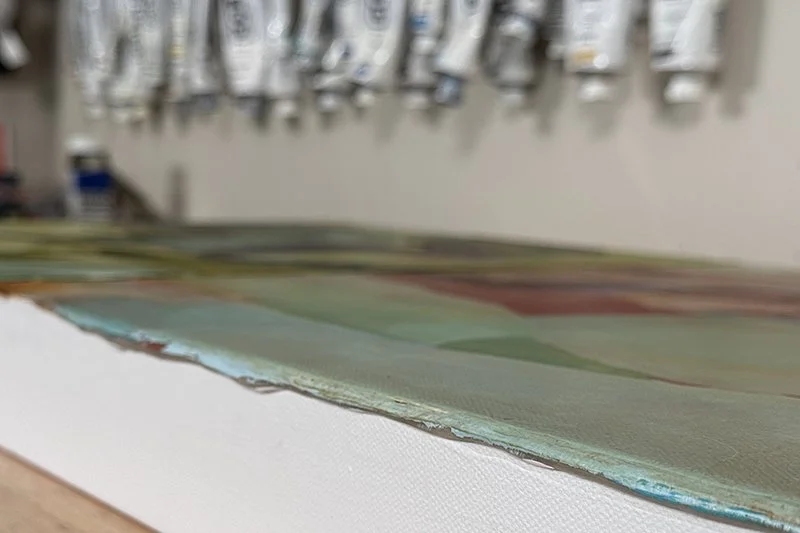
Medium on the edge of the new canvases. I decided not to make them perfect.
The way paint behaves on this prepared surface suits my style in a way that feels almost too good to be true. I have never been drawn to clean, precise work. I like surfaces that look lived in — worn, irregular, a little unpredictable. This process delivers all of that before I even pick up a brush.
For this stage of my practice, I think I may have found something. A new way of working that feels both intentional and a little wild, which is exactly where I want to be right now.
Of course, as with all good ideas, there is a catch — or at least an open question. The whole experiment started because wood panels had become too expensive. But acrylic ground for pastel isn't cheap either, and when you're applying it this heavily across six canvases, the cost adds up quickly. Whether this new process actually saves me money over panels in the long run remains to be seen. I may have simply traded one expense for another — and if that's the case, at least I'll be broke with better surfaces.
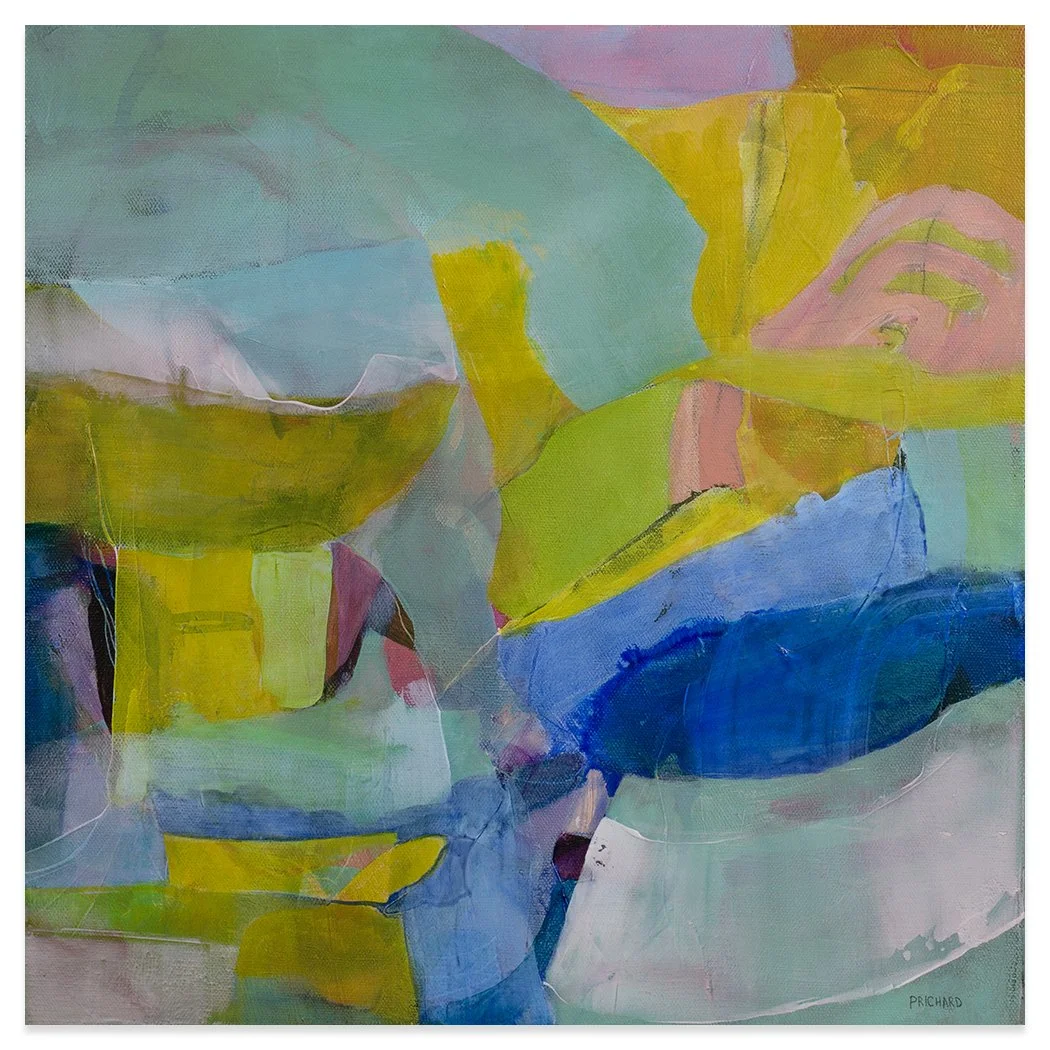
“Canary”, 2026- Julie Prichard. Acrylic on stretched canvas. Studying how layers react differently the medium applied to the canvas.