One of the questions I hear most often goes something like this: "I have this medium. Can I use it for what you're teaching?" Behind that question is usually an assumption that all the clear mediums are basically the same, and that they will give similar results. It's an understandable assumption. Pour any of them into a cup and they look alike: milky when wet, clear when dry, and a bit like glue.
They are not the same, though, and knowing why will save you time, money, and a lot of frustration in your studio. This article walks through what mediums actually do, how to tell them apart, and where sheen (gloss, satin, and matte) does and doesn't matter. To accompany my new release on Acrylic Glazing Techniques, I thought it might be a good idea to touch on all of your medium questions.
The Basics: What is a medium?
A medium is anything you mix with acrylic paint to change how it behaves. Each one allows you to manipulate the paint, but for different reasons. Depending on the medium, you can:
Make the paint more fluid or more buttery
Extend the paint so a little goes further, without thinning it too much
Make layers more transparent
Slow the drying time so you have longer to blend and move paint around
Build texture
Change the sheen of the finished surface
Notice that these are different jobs. A medium that is great at one of them may be poor at another. That is why picking up whichever bottle is nearby can lead to results that surprise you.
Should I buy gloss, matte or satin?
This is where I get the most confusion, so I want to be direct about it.
Gloss, satin, and matte mediums work the same way. If you are following along with a technique, the sheen you choose does not change what the medium does. A matte medium will let you glaze, extend, or layer just as a gloss or satin will. The main difference is how the surface looks when it dries.
The one real catch is vibrancy. Matte mediums contain a matting agent that scatters light, and that can make color look a little less intense. When layered repeatedly, matte medium can cloud what is beneath it. You will notice it most in dark colors, in thin transparent layers, and when you use a lot of the medium relative to the paint. Gloss lets more light through and keeps color looking deeper and cleaner. Satin falls in the middle.
So if you want your color to stay as vibrant as possible, gloss is a safe choice. If you like a flatter, more velvety look and don't mind a slight softening of color, matte is perfectly fine. Personally- I always use gloss and satin.
While sheen gets most of the attention, the consistency of the medium usually has a bigger effect on how it behaves. S ince you can always change sheen after the work has dried, take into consideration the viscosity of the medium you need.
Fluid or liquid mediums are thinner and easier to brush and blend. They are good for glazing, thinning, and smooth layers.
Gel and paste mediums are thicker. They hold brush marks, add body, and can be used to build texture or give paint a heavier feel.
Slow-drying or "open" mediums keep the paint workable longer, which is helpful for blending and soft transitions.
If a technique relies on slow drying or on a transparent layer, a medium that does not offer those qualities won't get you the same results, no matter what sheen it has. This is the most common reason someone tells me, "I followed the steps and mine looks different."
So- can I just use what I already have?
Often, yes, but it depends on what you have and what you're trying to do. A few questions help:
What job does the technique need the medium to do? Extending, glazing, slowing the drying time, or building texture?
Does your medium do that job? Check the label for its description and consistency.
Is the sheen the only difference? If so, you can almost always substitute. Just expect a different surface finish, and a small drop in vibrancy if you're using matte.
If the difference is in consistency or drying time, it's worth buying the recommended medium, especially for a first attempt. You will learn the technique more easily when the materials behave the way the instructions expect.
Beginning starting points:
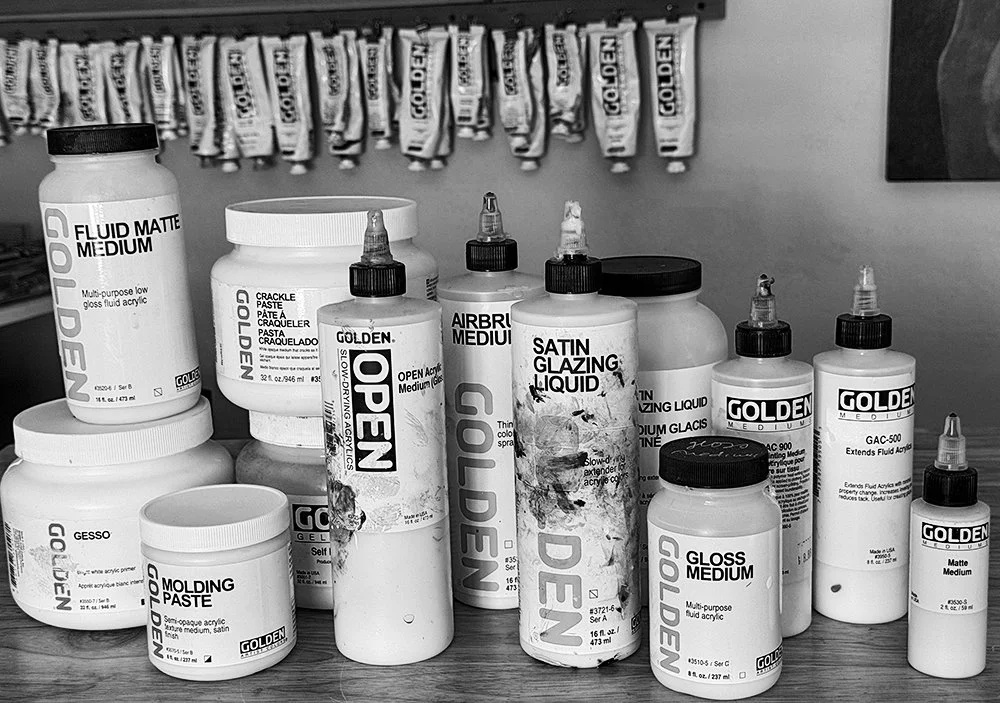
When starting to explore acrylic mediums, you don’t need a large collection.
If you are new to mediums, you don't need a shelf full of them. Start with one fluid medium in the sheen you like, and one that gives you a longer working time or a glazing effect. Try them side by side on a scrap of canvas or paper with the same paint, and see how they differ. That ten-minute test will teach you more than any description can.
Clear mediums may look alike, but each one lets you manipulate acrylic paint for a different reason. Sheen changes the finish, and matte can soften vibrancy, but beyond that the sheen won't change how the medium works. Consistency and drying time are what really set mediums apart. Choose the medium for the job you need it to do, and you'll get results that are far closer to what you expect.
Finally- an additive is different than a medium. So when shopping, be sure to read labels carefully. Additives can permanently alter the performance of your paint. Have any questions? Post them in the comments and I will answer them all as fast as I can. Happy painting!